
When an organization needs to extend its technology capabilities, two models dominate the conversation: staff augmentation and managed services. Both are effective. Both are widely used. And both are frequently chosen for the wrong reasons.
The real question isn’t which model is better — it’s which one fits your situation. Get that right, and you accelerate. Get it wrong, and you introduce friction, misaligned accountability, and cost overruns that are hard to unwind.
This guide breaks down how each model works, when to use each, and why the most effective organizations often use both — deliberately.
The Core Distinction
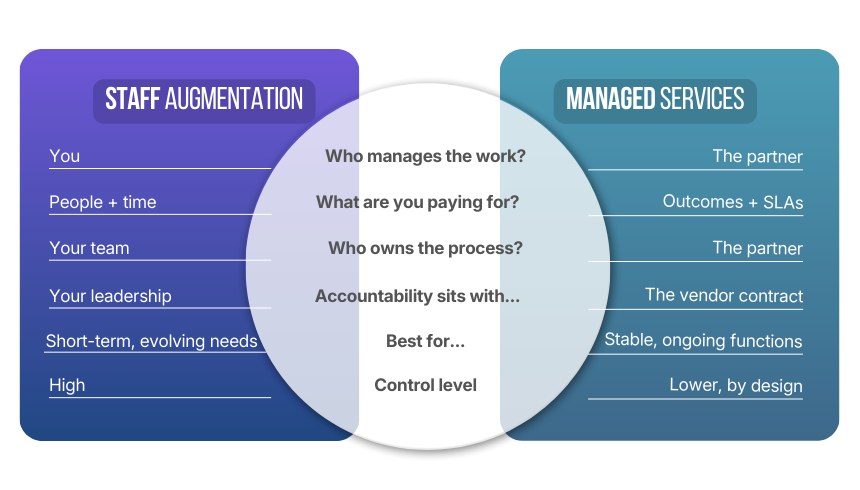
The simplest way to tell them apart: with staff augmentation, you manage people. With managed services, you manage outcomes.
Staff augmentation adds skilled professionals to your existing team. They work inside your structure, under your direction, following your processes. You own the decisions, the methodology, and the results. The arrangement is fundamentally about capacity.
Managed services hand off a defined scope of work to an external partner. They own the delivery, the team, the tooling, and the day-to-day execution. You hold them to SLAs and KPIs. The arrangement is fundamentally about accountability.

When Staff Augmentation Is the Right Call
Staff augmentation works best when you have the leadership capacity to direct people, and you need specific skills or bandwidth that aren’t available internally. It gives you flexibility and control — but you carry the management overhead.
Use staff augmentation when:
- You have a defined project and know exactly what needs to be built — you just need more hands or a specialized skill (a senior React developer, a cloud architect, a data engineer).
- You’re facing a temporary capacity crunch: a product launch, a platform migration, a sprint surge.
- The work is core to your product, and you want to retain the domain knowledge and decision-making internally.
- You have strong technical leadership who can absorb and direct outside contributors without creating bottlenecks.
- You’re considering a long-term hire and want to evaluate someone in your environment before committing.
One thing to watch: augmented staff won’t manage themselves. If your internal leads are already stretched, adding bodies can create noise rather than velocity.

When Managed Services Is the Right Call
Managed services work best when you want to hand off responsibility for a function, not just add people to it. The value isn’t just in the talent — it’s in the accountability structure and the operational continuity.
Use managed services when:
- The function is important but not core to your competitive differentiation — QA, DevOps, infrastructure monitoring, platform support, helpdesk.
- You want a partner accountable to outcomes, not just effort. You care about uptime, defect rates, or resolution times — not who’s doing the work hour to hour.
- You lack the internal expertise to manage the people doing the work. If you don’t have a security engineer, you can’t effectively oversee one.
- The work requires 24/7 coverage or scale that’s impractical to staff internally.
- You want predictable, fixed costs rather than variable time-and-materials billing.
- You’re trying to reduce operational overhead so your internal team can focus on higher-value work.
One thing to watch: managed services require well-defined SLAs and governance. Vague contracts lead to vague accountability. If you can’t measure it, you can’t hold anyone to it.
A Simple Decision Framework
When you’re unsure which model fits, these questions will usually clarify it:
- Do I want to manage these people, or manage a contract? If managing people is fine, augment. If managing a contract is preferable, go to managed services.
- Do I have strong internal leadership with bandwidth to direct this work? If yes, augmentation can work. If not, managed services fill the gap.
- Is this a short-term initiative with evolving requirements, or a stable ongoing function? Evolving needs favor augmentation. Stable, repeating workloads favor managed services.
- Is this work core to our product differentiation? If yes, keep ownership. If not, consider offloading it.
The trap many organizations fall into is using staff augmentation rates while expecting managed services accountability — wanting full control over the work without accepting full responsibility for managing the people doing it. That’s where engagements break down.
Why High-Performing Organizations Use Both
These models aren’t mutually exclusive — they’re complementary. The organizations that get the most value from external partnerships tend to use each deliberately, based on the nature of the work.
A common pattern: core development teams are augmented for flexibility and innovation. Supporting functions — QA, DevOps, platform maintenance, data pipelines — run as managed services. The core product stays under internal control; the operational layer runs reliably in the background.
At Excel Nearshore, we help clients design engagement structures that reflect this kind of intentional mix. The right model isn’t always one or the other — it’s the combination that matches your internal capabilities, your growth stage, and where you actually need ownership versus scale.
The Model Matters Less Than the Partner
Both models can fail when executed with the wrong partner. A great staff augmentation engagement requires someone who can integrate quickly, communicate proactively, and operate with minimal hand-holding. A great managed services engagement requires a partner who understands your context well enough to make good decisions without your constant input.
What separates a strong nearshore partner from a staffing vendor is the willingness to challenge assumptions — to tell you when the model you’ve chosen isn’t the right one, and to adapt as your needs change. The goal isn’t to fill seats or hit SLA checkboxes. It’s to build something durable.
Ready to find the right fit?
Whether you need additional hands on a specific initiative, full ownership of a function, or a combination of both — Excel Nearshore can help you structure an engagement that actually fits. Get in touch to talk through your situation.